I mentioned the Kalevala was one of my Desert Island books last week. It is. The Desert Island list is what it sounds like—if you were stranded on a remote island somewhere away from the honking of traffic, the onslaught of internet information, and could only carry ten books, what would they be?
It’s worth thinking about, and, I think, revisiting at various points in your life. It’s a good way to check in and see what’s changed in terms of values and passions, and to see if you’ve discovered some new treasure since you last thought about it.
So if I were stranded on an island in 2018, the books whose words I would feel lost if I could not read again are as follows, and you should know ahead of time that I intend to cheat:
A Collected Works of Geoffrey Chaucer. (See what I did there?) I don’t think I could live too long without access to the Canterbury Tales, but he has other lovely works, like the Legend of Good Women and the House of Fame that I would want those too, if we’re talking about forever.
Italo Calvino’s If on a winter’s night a traveler is also a frame narrative, or a story full of stories, and it’s the kind of book I’d reread once a year even if I didn’t teach it. It’s all about reading and writing and reading like a writer and writing like a reader, and I love it. There is a character who talks about translating like flow—moving in and out of languages like a fish swimming—and it has never left me.
Franz Xaver von Schonberg’s Collected Folk Tales. I used to say the Grimms,’ and I still love them, but if we’re only granted a limited number of books and they might be used to build a new civilization, I’d want the ones with more neutral gender roles, so we don’t have to relive all that damsel in distress nonsense.
The Arabian Nights. I get lots of stories here too, and since I know less about this area and language, I’d defer to the translation by Husain Hadawy, my first year composition instructor from the University of Nevada, so many moons ago.
The Mabinogion, a collection of medieval Welsh folklore and legends with some marvelous characters and scenes, like Caumniated Wives and Wizards who use transfiguration as a punishment.
The Brothers Karamazov by Fyodor Dostoesvsky because we probably should have a traditional sort of novel, and Grushenka’s onion was instrumental in my forming healthy adult relationships.
Collected Poems of Emily Dickinson because we probably should have an American, and Dickinson’s poems craft images as if out of clouds.
A World Mythology collection because it’s good to know where we came from and how much we have in common.
Ovid’s Metamorphoses, and I favor Allen Mandelbaum’s translation. But let’s face it, if I were on an island, I’d have lots of time to work up my Latin, so I should have a dual-language edition. I love so many of these stories so deeply, but the stories of Proserpina and Orpheus alone would merit its inclusion—Proserpina/Persephone so we remember that death and life are inseparable, and Orpheus so that we remember that while art can do almost everything, it cannot bring back the dead—nor do we mortals need it to.
And last, but not least, The Kalevala, because of all the reasons I mentioned last week and because it’s good to remember that words are magic and can change your world.
This is where I am now. If I were honest, I’d say I need ten picture books, ten children’s novels, ten poets, ten novels, ten essayists, and ten non-fiction, but this is where my mind lives most often at this stage in my career and life, and it is a happy place. A folkloric, mythic, medieval wonderland with only occasional forays in to the modern world, and usually by those who value the past.
Of all the personality inventories and internet quizzes that crank out a conclusion about us based on what we like, I think which stories we could not live without is probably the most accurate, at least for me. I need magic. I think in archetypes. I revel in beautiful words and compelling images. And I view story as the most valuable thread back to our collective past and in to our individual selves.
Showing posts with label Mabinogion. Show all posts
Monday, October 29, 2018
Monday, November 6, 2017
Beginning the Mabinogion Again
This is an excerpt from a new project I'm working on--a reworking of the Welsh Mabinogion. It's just a bit--just because I'm swamped this week and need to use something here that already exists. I hope you enjoy it; I'm having a blast.
Chapter 1: The Hunt Gone Wrong
Sometimes a hunt is nothing but sweat and dirt and
waiting. Not this time. Pwyll’s heart beat in time with his horses’
pounding hooves, and the trail was hot. He was chasing a stag, fast and sleek, and instinctively elusive. But this one wouldn’t get away. This one was white, and stood out in the dark
leaves like a beacon, luring his dogs on in to the woods. When something leads you like that, you
follow, and you ask questions later.
In and out of trees, the stag seemed to flow like a river,
without stumbling or snagging a single branch.
Later he might reflect on that and find it odd, but not in the
moment.
Adrenaline pumping, he charged
recklessly after the dogs. Five dogs: there were generally four together and then
Finn swerving around, herding them, faster than the others and capable of
switching back and steering the whole pack.
The barking was steady for several minutes, and Pwyll’s
energy was flagging. He couldn’t keep up
this breakneck pace forever. His horse
was tired, and so was he. They had to
end it soon, or there would be nothing but sweat and dirt to take home. A dog yelped shrilly, and the barking
stopped. Finn bayed like they must have
cornered the deer, but when the horses caught up with the dogs, what Pwyll saw
made his breath catch. The dogs were
circling a small mound in a clearing that backed up against a sheer wall of
stone. Pwyll quietly said a prayer of
thanks that he hadn’t run his horses headlong in to the clearing—they surely
wouldn’t have been able to stop in time and would have smashed in to the stone. The stranger thing still, was the deer had
vanished.
Finn looked miserable. He ran the opposite way around the circling dogs, howling, his eyes
sweeping the clearing for any trace of his quarry. The dogs sniffed furiously, noses to the
ground, one after another around the mound.
“Where’d it go, Finn?” Pwyll asked cautiously. “It
didn’t leap up that wall, surely.” Of
course not, the dogs’ noses were saying, as they rounded the hillock
again.
Pwyll hopped down from his horse and joined the procession
of dogs. Finn stopped baying and looked
up at him quizzically. “What now?” he
seemed to ask. “I don’t know,
buddy.”
Pwyll sat down hard on the
mound, exasperated, and a puff of dust rose up around him.
Finn sniffed the dust and sneezed. Then he backed up, growling.
“What’s up, Finn?” The
words were just out of his mouth when the dog blurred and shimmered, and the
sound of running animals startled Pwyll off the mound. As he scrambled to his feet, the stag
streaked past him, and the dogs took off back in to the woods. “Where did he come from?” he yelled to no
one, and headed back to his horse. He
began to swing on to the horse, and a pack of snow white dogs barreled by him,
knocking him to the ground.
“There must be twenty of them! Whose are they?” This time he was asking the horse, Llewellen,
who snorted indignantly. As they resumed
the chase, Pwyll heard the barking, steady and loud and cacophonous, and then
it thinned, like fewer dogs were barking. In a few seconds, he understood why—his dogs
had been passed up and then left behind. The white dogs were faster, and they had led the quarry away.
“No!” Pwyll shouted, drawing up Llewellen in to a slow trot
and letting everyone catch their breath. “And we were so close! Where did
those dogs come from?” he hounds whined
sympathetically, and panted prodigiously. They were worn out. “Let’s go get
a drink,” said Pwyll, and he led them over toward the river.
Sweat and dirt again. He sighed. As he walked his horse
and his tired dogs through the trees, he thought of excuses he could give for
coming up short today. They wouldn’t
believe his story about crazy white dogs that appeared out of nowhere. He could already hear Gwyn mocking him.
As he dipped his hands in to the river for a drink, he heard
the barking start up again, distantly. They were coming back. He
splashed the water on his face instead of drinking it and hopped back on
Llewellen. "We might have another
chance!” he called, and off they drove in to the trees.
They found the dogs back at the mound, in a pack around the
deer, who lay on its side on the earth. “Hah! Off! Off!”
He ran his horse in a circle, hooves pounding and breaking up the dogs. Two of the white hounds left the deer and
attacked Llewellen. Pwyll stabbed his
spear down in to the fray, skimming one on the shoulder and piercing one
through the leg. He swung the dog around
by that leg—the dog’s ears were bright red—and tossed him off to the side. He chased the other dogs away from the deer,
back in to the woods where he came from.
When he returned, his own dogs were harrying the deer. They knew not to eat the body, but the deer
was dead, and they were chewing on its legs and antlers. “That’s enough, guys. Let’s get this beauty home,” he called. He leaped to the ground and knelt to inspect
the stag. “It's amazing! I’ve never seen anything like
it.” The whole pelt was white, except
the ears, which were blood red. The
eyes, too, open in that awful, frozen stare, were red. He closed them gently and shook his
head. “I’ve really never seen….”
“Of course you haven’t,” came a stern voice from behind
him. “It’s not from around here.” A tall, black-clad man on an enormous,
heaving stallion stood so close to him, Pwyll jumped. How had he not heard his approach? The horse snorted, and the man leaned down,
pulling his hood back off his face, enough to reveal intricately tattooed skin
and sunken, fiery eyes.
“Neither am I.”
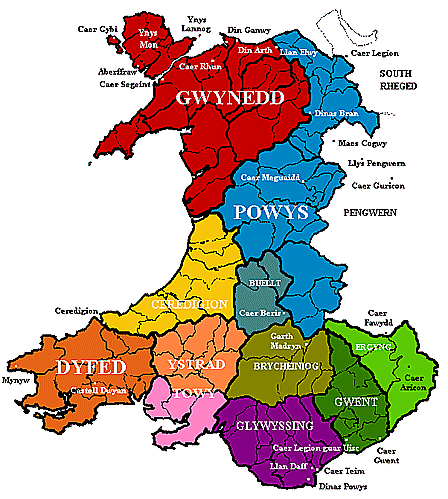
(That's a map of Medieval Wales, by the way.)
Subscribe to:
Posts (Atom)