Eek.
A wise young woman just told me if I want people to keep reading my blog, I should tell them I've moved it. I have!
I'm so sorry!
I now post on Wordpress at ahouseofstories.home.blog
I have kept posting, now on Thursdays, so there are some to catch up on if you're interested, and they're sorted in to topics for easier consumption.
Thanks for reading on Blogger. I hope to see you on Wordpress!
Happy summer!
Alison
Thursday, July 11, 2019

Monday, December 17, 2018
On Iceland's Yule Book Flood

I have loved Iceland since grad school. I took some Old Norse
classes, read some Icelandic history, and even
found a way to study one summer in Reykjavik, glacier-climbing and geyser-watching in person. The Icelandic language is quite
conservative (read: “it hasn’t changed much”) due to isolation and intention, so
folks who speak modern Icelandic can read Old Norse. And they do—Icelandic kids read sagas like American kids read Tall Tales. My favorite word in the world (which is saying a lot—I
like a LOT of words) is the Icelandic noun uppivǫzlumaðr,
which means a “pushy, contentious/tempestuous man.”
All of this awesomeness pales in comparison, though, to the
best thing about modern Icelandic culture: the Yule Book Flood. On Christmas
Eve in Iceland, people exchange books and turn in early to read and eat
chocolate in bed. These are my people.
Iceland has always been exceptionally literate, producing long,
complicated sagas and dense, interlocking poems since the Middle Ages, as well
as vast corpuses of legal texts and proceedings. Today Iceland remains extremely
literate, with more books printed per capita than any other country, and with one in
ten people publishing a book.

The Yule Book Flood, though, has a little more to do with
happenstance than spontaneous awesomeness. During World War II, strict
restrictions on imported giftware made paper, which wasn’t taxed as highly,
more desirable. So everyone started buying books for gifts, and it stuck.
On November 1st, the catalog of all the new books
comes out and is delivered all over the country. Fiction and biography sell the
most, so I love to imagine a whole nation settling down to storytime, chocolate
in hand.
How do we bring this kind of book-love to the US?
I once saw on Pinterest a cute idea of wrapping up a picture
book for every day of Advent to read a special holiday story. That was great,
and I bought a few new books for it and dug out some other, less recently read
books, but it failed ultimately, because my kids were never satisfied with one
picture book. They were used to five or more a night, so they wanted me to wrap
five a night instead of this one-book nonsense. Thus ended the Book Advent
tradition.
I do give books for holidays—birthdays and Christmas—but since
they also get family presents on Christmas Eve at my house (an age-old Baker
strategy to stretch out the holiday), we tend to play games on Christmas Eve
together, not read books by ourselves.
But in the years to come, when our munchkins have established their own
households and traditions, I see a Baby Book Flood in our future.Two little
old married people snuggled down with new books (though Rob will likely be
listening to his on ear buds or whatever replaces them) and plenty of
chocolate. I’ll insist on the chocolate.
Happy holidays, everyone.
Monday, December 10, 2018
Holiday Picture Book Extravaganza

Ok, maybe it’s not an extravaganza, but it’s one more than
the last two years. Yay!
I haul out all our holiday picture books from the rec room
for the month of December every year. When the kids were little, it meant we
read holiday picture books almost exclusively for story time. Now that they’re
big, it means we all sort of steal one and snuggle down surreptitiously for ten
minutes of delight and nostalgia before going back to whatever homework/grading/finals
sort of demand we’re facing.
This year I have a mix of old favorites and new treasures—from
the traditional 12 Days of Christmas to the Sugar Plum Fairy who happens to
have two dads. And then there’s the happy pagan winter tale, slightly updated,
of Lucia, the little girl who faces down trolls to bring back the light.
Whether you have someone young to share these with or not, I
promise they’re all worth your time.
 1. Laurel Long’s “The Twelve Days of Christmas” is far and away
the most visually stunning version I have ever seen. I have loved her work for
years, especially her fairy tales “The Lady and the Lion” and “The Magic
Nesting Doll,” but this one tops everything she’s ever done in my opinion. She
includes each of the previous list of element in every page, so you can search
for the partridge in every spread and the two turtle doves after the second,
and all of them—ALL OF THEM—in the last spread. In the tradition of Graeme
Base, this is amazing work.
1. Laurel Long’s “The Twelve Days of Christmas” is far and away
the most visually stunning version I have ever seen. I have loved her work for
years, especially her fairy tales “The Lady and the Lion” and “The Magic
Nesting Doll,” but this one tops everything she’s ever done in my opinion. She
includes each of the previous list of element in every page, so you can search
for the partridge in every spread and the two turtle doves after the second,
and all of them—ALL OF THEM—in the last spread. In the tradition of Graeme
Base, this is amazing work. 2. “Lucia and the Light” is a rework of the trickster tale
where the hero goes to fetch the sun from thieves. In Phyllis Root’s version,
illustrated with big-eyed wonder by Mary Grandpré, the hero is a little girl
whose name means ‘light,’ and the thieves are giant rock trolls. Lucia is loving
and clever and brave, and she has a milk-white cat who is part sidekick, part
familiar, and all delightful. My daughter was four when we got this, and she
still reads it when I pull it out.
2. “Lucia and the Light” is a rework of the trickster tale
where the hero goes to fetch the sun from thieves. In Phyllis Root’s version,
illustrated with big-eyed wonder by Mary Grandpré, the hero is a little girl
whose name means ‘light,’ and the thieves are giant rock trolls. Lucia is loving
and clever and brave, and she has a milk-white cat who is part sidekick, part
familiar, and all delightful. My daughter was four when we got this, and she
still reads it when I pull it out.
3. Do you know I love bunnies? And Nordic things? Especially gnomes,
or as the Swedes call them, tomten? Ulf Stark and Eva Eriksson have a couple
books out about “The Yule Tomte and the Little Rabbits” and one for Midsummer
as well. The stories are sweet, and the illustrations are precious. They’re
aimed at little ones, maybe 3-7 years, but I enjoy them both.
4. This year’s new discovery was “Plum: How the Sugar Plum
Fairy Got Her Wings” by Sean Hayes and Scott Icenogle of Will and Grace fame, illustrated by Robin Thompson. This is the
little-known backstory of the plucky orphan who becomes the princess of the
Land of Sweets, and, when she’s learned to be generous of spirit, she earns her
fairy wings. Pretty sweet.
 5. Finally, there is “Auntie Claus” by Elise Primavera, another
of my favorites from reading with the kids. Auntie Claus is Santa’s sister, and
little Sophie sneaks out and stows away to learn the family secrets. This is imaginative
and funny, and there’s a rule-spouting elf named Mr. Pudding. I’m thinking that should be enough. If it’s
not, the illustrations are delightful, and once or twice you have to turn the
book sideways because the text and illustration demand it, so that’s always a plus.
5. Finally, there is “Auntie Claus” by Elise Primavera, another
of my favorites from reading with the kids. Auntie Claus is Santa’s sister, and
little Sophie sneaks out and stows away to learn the family secrets. This is imaginative
and funny, and there’s a rule-spouting elf named Mr. Pudding. I’m thinking that should be enough. If it’s
not, the illustrations are delightful, and once or twice you have to turn the
book sideways because the text and illustration demand it, so that’s always a plus.
There you have it: this year’s five picture books for the holidays.
I hope you find time to check them out. I’ll happily read them, I mean loan
them, to you if you like.
Merry merry, everyone.
Monday, December 3, 2018
Wisdom Poetry and the Modern Mind
Y’all, I’m still on about memory. The upshot of Maryanne Wolf’s
book on reading in a digital world is that the brain’s structure reflects what
it does. That is, if we give it nothing but flashing ephemera, it will rewire
itself to handle that well, and not to handle deep, prolonged thought. This is
a problem for the future of the academy, but more importantly for the future of
democracy, which depends upon the people thinking well.
 Odin is a god of war and wisdom. What I liked most about the
Marvel movie Thor: Ragnarok was the
scene where Hela (who is NOT Odin’s daughter in the myths, but Loki’s) breaks
the ceiling and reveals the inglorious past. Odin is a war god. We sometimes
forget that.
Odin is a god of war and wisdom. What I liked most about the
Marvel movie Thor: Ragnarok was the
scene where Hela (who is NOT Odin’s daughter in the myths, but Loki’s) breaks
the ceiling and reveals the inglorious past. Odin is a war god. We sometimes
forget that.
These wisdom poems serve lots of functions besides painting beautiful mental images of Norse culture. They are designed to be memorized and performed, and they preserve cultural knowledge like fairy tales and other oral texts do.

 So they memorized Odin’s words and preserved them. In later
periods they wrote them down. Snorri Sturluson, in the 13th century,
tried to summarize and capture them in sort of Reader’s Digest Condensed
versions, and he did so with academic interest and cultural pride. The result
is that we have a good number of texts that don’t fit the adventure narrative or
the divine intervention myth. In lots of them, Odin just talks.
So they memorized Odin’s words and preserved them. In later
periods they wrote them down. Snorri Sturluson, in the 13th century,
tried to summarize and capture them in sort of Reader’s Digest Condensed
versions, and he did so with academic interest and cultural pride. The result
is that we have a good number of texts that don’t fit the adventure narrative or
the divine intervention myth. In lots of them, Odin just talks.
Have I got your attention? Good. I want to talk about
vikings.
 Odin is a god of war and wisdom. What I liked most about the
Marvel movie Thor: Ragnarok was the
scene where Hela (who is NOT Odin’s daughter in the myths, but Loki’s) breaks
the ceiling and reveals the inglorious past. Odin is a war god. We sometimes
forget that.
Odin is a god of war and wisdom. What I liked most about the
Marvel movie Thor: Ragnarok was the
scene where Hela (who is NOT Odin’s daughter in the myths, but Loki’s) breaks
the ceiling and reveals the inglorious past. Odin is a war god. We sometimes
forget that.
How do war and wisdom go together? Well, you can buy the
Marvel reading and say after the war comes the wisdom; that works. But in the myths,
Odin is a war god throughout. He fights a war against the Vanir—the fertility
gods—until it’s clear no one will win, really. (Imagine how much we would save
if we had that wisdom.) He visits battlefields, blessing warriors with strength
and strategy, and he collects soldiers in Valhalla against the coming of Ragnarok.
He is the patron of kings, part of whose job description is knowing when and
how to wage war.
But he’s also the god of wisdom. The other part of the king’s
job is knowing when not to fight--knowing how to support, sustain, and provide
for your people. And it means knowing what it takes to ensure a civilization
endures.
Old Norse myths include rollicking stories of adventure, but
they’re also full of wisdom poetry. I have a whole day in my myth class devoted
to wisdom texts.
These wisdom poems serve lots of functions besides painting beautiful mental images of Norse culture. They are designed to be memorized and performed, and they preserve cultural knowledge like fairy tales and other oral texts do.

They almost always feature Odin. Odin hangs himself on Yggdrasil
(“The World Tree,” or more literally, “Odin’s Steed’) to learn the runes. He
journeys to Jǫtunheim to challenge the giant Vafthrudnir (“Riddle-Weaver”) to a
contest of knowledge. He journeys to the underworld to talk to dead witches and
learn from them, and he tests others, including his own son, Thor, while in disguise.
Odin never stops wanting to learn more and test how much he knows.
He shares his knowledge with kings, in an effort to improve
the world. He’s a believer in trickle-down wisdom. When a king he’s trained
doesn’t work out, he tests him first and then instructs and installs his
replacement. We know all this because there
are numerous poems narrating his exploits and filled with stanza after stanza
of truths Icelanders did not want to lose. These texts read like the biblical Proverbs or
the Welsh Triads, with small, pithy messages in series.
 So they memorized Odin’s words and preserved them. In later
periods they wrote them down. Snorri Sturluson, in the 13th century,
tried to summarize and capture them in sort of Reader’s Digest Condensed
versions, and he did so with academic interest and cultural pride. The result
is that we have a good number of texts that don’t fit the adventure narrative or
the divine intervention myth. In lots of them, Odin just talks.
So they memorized Odin’s words and preserved them. In later
periods they wrote them down. Snorri Sturluson, in the 13th century,
tried to summarize and capture them in sort of Reader’s Digest Condensed
versions, and he did so with academic interest and cultural pride. The result
is that we have a good number of texts that don’t fit the adventure narrative or
the divine intervention myth. In lots of them, Odin just talks.
The most famous of these is the Hávamál, or “The Sayings of the High One (Odin).” It is a long,
aphoristic list of guidelines for how to behave and live well, followed by a
diagogue with a king, and ending with an account of Odin’s acquisition of the runes.
Its wisdom is no less pertinent today than it was in the Middle Ages.
That’s the real reason we need to remember—because we’ve
learned a lot of this stuff before, and if we don’t waste time relearning, we
can go farther faster.
(The Old Norse poems I refer to in these last paragraphs are
the stories of Odin meeting Vafthrudnir, the Vǫlva, Thor, and the king Geirrod,
and I’m happy to suggest translations if you’re interested.)
Monday, November 26, 2018
The Saga of Moira Aschenputtel
Reading with a cat (or dog!) is one of my favorite images of
contentment.
There’s something soothing about the quiet it requires, the warmth of the fuzzy one curled up on a lap or on the floor nearby. It’s an image of comfort, as we imagine the person sitting for a period of time, reading in quiet companionship. And a cat or dog, who can’t interrupt (at least not with speech) evokes a shared silence conducive to reading.
 In the months that followed, she stayed home more. She seemed
to sleep more. Carrie described her as lazy. The truth was they were both
cocooning, trying to decide what shape their life would take moving forward. My
cousin made the decision to stay in the house. She resolved to renovate and redecorate and
make the house hers--to shape her next phase of life purposefully.
In the months that followed, she stayed home more. She seemed
to sleep more. Carrie described her as lazy. The truth was they were both
cocooning, trying to decide what shape their life would take moving forward. My
cousin made the decision to stay in the house. She resolved to renovate and redecorate and
make the house hers--to shape her next phase of life purposefully.
There’s something soothing about the quiet it requires, the warmth of the fuzzy one curled up on a lap or on the floor nearby. It’s an image of comfort, as we imagine the person sitting for a period of time, reading in quiet companionship. And a cat or dog, who can’t interrupt (at least not with speech) evokes a shared silence conducive to reading.
I was lucky enough to spend many hours over Thanksgiving
break in such a position. I feel very rested.
I have spent many hours reading with pets over the years,
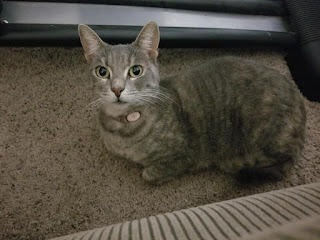
but this weekend was a little different. This weekend we adopted a new cat because
her person, my cousin, recently died. This kitty has quite a story.
This kitty found and claimed my cousin’s husband about four and a
half years ago. She was alone and needed a home, and they were mourning the
recent loss of their previous cat. It was perfect. Brian was retired and lonely
while his wife was at work, so the cat became his companion, and in the way
these things go, they rescued each other.
But then he got cancer. He was strong and healthy, and he
kicked it, but it came back with a vengeance. Through a second round of chemo and
some alternative medicines, including trips to far-off retreats and Bucket List
vacations, the kitty stayed close, offering what comfort she could. When he
died, she was the only other heartbeat in the house, and Carrie was consoled,
but still bereft.
A married woman for two thirds of her life, Carrie was lost
without her partner. The kitty was a tie to him, but also a reminder of her loss. After
a few months, the cat started wandering off for longer and longer periods.
She was on walkabout when the fire came.
When Carrie evacuated, seriously fearing for her house and
property, she looked high and low for the cat. The school where she taught third
grade closed for over a week. She took refuge at her parents’ house fifteen
miles away. She feared for the little gray cat alone in the smoke and ash. Ten
days later the kitty returned--haggard, dirty, hungry, lonely.
 In the months that followed, she stayed home more. She seemed
to sleep more. Carrie described her as lazy. The truth was they were both
cocooning, trying to decide what shape their life would take moving forward. My
cousin made the decision to stay in the house. She resolved to renovate and redecorate and
make the house hers--to shape her next phase of life purposefully.
In the months that followed, she stayed home more. She seemed
to sleep more. Carrie described her as lazy. The truth was they were both
cocooning, trying to decide what shape their life would take moving forward. My
cousin made the decision to stay in the house. She resolved to renovate and redecorate and
make the house hers--to shape her next phase of life purposefully.
But just as she seemed to be finding her footing, she went
to sleep one Saturday night and didn’t wake up.
The cat went rogue.
How much, really, should one little cat have to take? How
much can any of us take? She came and went, and the neighbors put food out for
her, but she didn’t live there anymore. No one did. Instead, she watched.
In the weeks that followed, the house was emptied. The last
ties to her people were boxed and bagged and donated and dumped. What reason
could she have for staying there? The food, sure, but nothing else, really--at least not until the sweet voice and soft hand of a sixteen
year old girl who scratched her ears and cleaned the cobwebs off her whiskers.
We went to help clean the house last weekend and came home with a new kitty cat. We have pets,
and she was dirty and flea-addled, so she needs to be quarantined for a bit
while she heals and recovers and adapts. And while she does, we’re taking turns
doing our various homework in the back room with her. Because reading with a
cat is the best way to read.
Monday, November 19, 2018
The Grateful List for 2018
It’s no secret that the United States is going through a
divisive, difficult time. Human rights
issues I keep thinking we should be long past are flaring up everywhere.
People’s very identity is being questioned, challenged, denied. The divide between
the rich and the poor is unspeakably wide, fomenting tragedy after tragedy. And
old, medieval-era hatreds are sadly, not dead.

 I’m grateful for my family. Though I feel deeply for so
many, my own life is marked by luck and serendipity and undeniable privilege.
I’m grateful to be able to raise my kids as I like—in comfort and in love—and
to have a partner who partners. When the world feels chaotic, they sort me and
support me. My daughter reads me well and administers hugs when needed. My son
tells stories and plays games to bring people together. My husband makes me
laugh every single day.
I’m grateful for my family. Though I feel deeply for so
many, my own life is marked by luck and serendipity and undeniable privilege.
I’m grateful to be able to raise my kids as I like—in comfort and in love—and
to have a partner who partners. When the world feels chaotic, they sort me and
support me. My daughter reads me well and administers hugs when needed. My son
tells stories and plays games to bring people together. My husband makes me
laugh every single day.
(These pictures are from one of my favorite photographers, Tiina Tormanen, and from Tove Jansson's Moomintroll books. Viva Finland.)
So what, then am I thankful for this Thanksgiving? The
usual. People.
I’m grateful that Ruth Bader Ginsburg is back to work the
day after she cracks ribs.

I’m grateful that my husband teaches, reaches, and defends
Dreamers and other vulnerable students.
I’m grateful that my kids go to a diverse school where they
are asked to engage real world problems and read a wide variety of texts—that
their friends include Muslims and non-binary kids and immigrants and that they respect
one anothers’ differences while learning to build bridges, not walls.
I’m grateful for young voters.
I’m grateful for artists—for painters and songwriters and
musicians and storytellers—for everyone who makes us see new beauties and
question old patterns.
I’m grateful for my cousin Carole, who passed away this
fall, but who leaves behind a legacy of hard work improving literacy in her
third grade classes, and for my aunt and uncle, her parents, who spent part of
their retirement decorating her classroom, stocking her library, and reading at
storytime—filling gaps in funding and staffing with service that so many classrooms in the
US need.
I’m grateful for the firefighters, first responders,
emergency crews, and neighbors who come together during disasters like the
horrific wildfires California has endured this month. For the Auburn Girls Volleyball team, who lifted up the Paradise team, raising money, providing new
uniforms and equipment but also food and companionship and solace.
 I’m grateful for my family. Though I feel deeply for so
many, my own life is marked by luck and serendipity and undeniable privilege.
I’m grateful to be able to raise my kids as I like—in comfort and in love—and
to have a partner who partners. When the world feels chaotic, they sort me and
support me. My daughter reads me well and administers hugs when needed. My son
tells stories and plays games to bring people together. My husband makes me
laugh every single day.
I’m grateful for my family. Though I feel deeply for so
many, my own life is marked by luck and serendipity and undeniable privilege.
I’m grateful to be able to raise my kids as I like—in comfort and in love—and
to have a partner who partners. When the world feels chaotic, they sort me and
support me. My daughter reads me well and administers hugs when needed. My son
tells stories and plays games to bring people together. My husband makes me
laugh every single day.
I’m grateful for my colleagues and my students, who strive every day toward improving the world. And I’m grateful for the opportunity to
be able each day to try and do a little more.
I wish you a full belly and a full heart this Thanksgiving,
friends. And maybe a little time just to sit and be.
(These pictures are from one of my favorite photographers, Tiina Tormanen, and from Tove Jansson's Moomintroll books. Viva Finland.)
Monday, November 12, 2018
Memory, the Mother of the Arts
The Greek goddess Mnemosyne is the goddess of memory. She is
the mother of the Muses. So memory gives us the arts.


The Muses are the goddesses of inspiration who bless mortals
with the gifts of song, dance, and contemplation. There are muses of epic
poetry (Calliope), of lyric poetry (Euterpe), of love songs (Erato), of songs
to the gods (Polyhymnia), of history (Clio), of chorus and dance (Terpsichore),
of tragedy and comedy (Melpomene and Thalia), and of astronomy (Urania).
All of these arts rely on memory. Creating and performing
these works means holding lines of verse, tunes, and motions in your head,
keeping them in order, delivering them with the grace of a goddess. If we don’t
have good memories, we can’t be good artists.
For all its miracles, Google is not helping us in the memory
department. Don’t get me wrong; Google is amazing and powerful. I once employed
its virtuosic search engine to identify a particularly nasty bug in my
bathroom. I typed “big-ass bug with too many legs” in the glowing bar, and it
delivered image after image of exactly the thing: a house centipede. So I know
its phenomenal capabilities.
What I worry about is how much people are coming to rely on
it. Sometimes I feel like my students have very little impetus (beyond the fear
of failing quizzes) to remember anything; they’ll just Google it. My partner teaches chemistry. He has seen students who know the molecular weights of elements
Google the weight of a compound instead of simply adding the weights together.
This seems small, I suppose, but I think it’s probably… not
small.
When we stop calculating, we slowly lose the ability to
check Google’s responses. When we stop memorizing things, we forget how to. When
we don’t have stories and details and random facts that we find cool stored in
our heads, we have nothing from which to create new worlds and solve the
problems of this one. Memory is the mother of creativity.
It behooves us, then, to increase our memory. We need to go
to the mental gym, not just the muscle gym. Those things that help us remember
things? They’re called mnemonics, from Mnemosyne. Here are a few that always
work.
Tell a story. If
you want to remember a fact or a lesson, give it a narrative. We love stories
(as evidenced by the fact that squarely seven and a half of those muses work in
words). If you want to teach children to stay away from strangers, you tell
them “Little Red Riding Hood.” If you want to teach them multiplication tables,
it works there too. (There’s a video called Times Tales that animates numbers
with narratives and helps kids memorize even math facts with stories).
Make a list. When
we group things together that are similar, we visualize them together and see how
they connect to each other. We have a tremendous ability to remember lists, whether
we make up jingles for them or see them in our mind’s eye. Thinking of things’
similarities helps us remember them.
Visit your Mind
Palace. Long before the BBC Sherlock visualized his Mind Palace to recall
things, medieval folks imagined mental cathedrals, slotting facts or story
blocks or shopping lists in to the stained glass windows of a cathedral and
imagining themselves walking through it, seeing the items in order.
There are many more. When I have my students create journals
for my Myth as Literature class, I give them complete freedom to use whatever
tricks they can to help them remember the stories. Some make elaborate family
trees. Some draw comics of their favorite scenes. Some write Tinder biographies
of all the gods. Some theme their whole journal around what drink a god or hero
would order at Starbucks and why it’s appropriate.
We need to do more of this, not less. We need to figure out what
method works for us individually and what has a good track record on the whole,
and we need to start employing these tricks. I’m heartened by the resurgence in
Commonplace Books and Art and Bullet Journaling; there does seem to be a trend currently to
write things down that we want to remember.
Whatever we do, we need to combat the tendency to offload
all our knowledge in to data files and websites. Otherwise we risk not only
losing our ability to be creative, but also our own stories, our own lives, in
the waters of Lethe, the River of Oblivion.
Monday, November 5, 2018
The Case for Joy, or the Other Side of Job
There is a significant thread in Chaucer’s Canterbury Tales considering the issue
of the biblical "Book of Job." "The Clerk’s Tale" tells the story of Patient Griselda,
a folk heroine often likened to Job. The Wife of Bath, in her Prologue, casts
herself as Job’s wife, telling her husband to curse God and die. Other tales
make reference more obliquely, but it is clear that it is a running trope, and
that Chaucer keeps bringing it up from different angles invites us to ruminate
on the lessons it teaches.


A painfully short summary of Job, so we’re all on the same
page, is: Job is a wealthy man with a large family, and Satan tells God it’s
only because of his many blessings that he is so devout; if God took away his
gifts, Job would curse Him. God tests Job by having his crops fail, his
children die, his body afflicted with sores—the works. His wife tells him to
curse God. He does not. He does, however, question God, reporting that everyone
around him thinks he must be pretty awful for God to be punishing him so. God
even responds, and when He does, he explains that humans have too narrow a
vision of suffering. It is not a result of sinning; it is character-building.
God wins his bet, and Job gets everything back—even new kids.
Tonight it’s the narrow understanding of suffering that
catches my attention. Do we need suffering to become our best selves? It certainly
builds sympathy, but I like to think empathy can be developed through our
imagination, not just experience. For tonight’s blog, my friends, you need to
know that I am an incontrovertible happy-ass. (“Optimist works too, but you lose
the “happy, and I’m not ok with that.”)
I think we can imagine other people’s suffering and learn
from it. Not as viscerally, certainly, but I don’t think we need to suffer
everything to realize some things are terrible. I’ve never lost a limb, but I
can imagine how that might change my life. I have had heart problems, but I don’t
think I feel any more deeply for others with heart problems than for those who’ve
lost limbs.

You can feel free to argue with me on this point, but if you
wait, I’ll give you another one to argue. I want to consider the opposite conjecture
tonight. We may have too narrow an understanding of suffering, but if so, we
also suffer from an inadequate appreciation of joy.
If suffering builds character, joy defines it. The things
that give us joy are the things that make us unique. You can’t choose what gives
you joy any more than you can choose whom you love or whether or not you like brussels
sprouts (I do—they make me feel like a giant Mopsy Rabbit raiding Mr McGregor’s
garden), so we kind of identify and understand ourselves by those affinities.
When we feel joy, when we’re super giddy and delighted, we
seem to sport a sort of shield against the world’s woes. When I’m on my way to
class to teach a text I particularly love, I bounce a little and dance a little
and smile really broadly. Mostly it’s infectious, but sometimes it’s disconcerting
for folks. But that just entertains me more because I’m already in joy-mode,
so my shield is up and other people’s lack of understanding doesn’t dim me at
all. You know the geeks who get all goofy when they talk about what they love;
that’s what I’m talking about.
There is power there.

The smaller moments
of joy matter too—what the Danish call “hygge,” or cozy delight. They mean the
warm, fuzzy feeling you get wearing warm, fuzzy slippers in front of a fire while
drinking something warm and (not fuzzy) delicious. The point is clear. We use
the metaphors because the physical feelings are so deep. That is joy too, if calm
and simmering rather than bouncy and electric.
Another thing joy does for us, in addition to helping us
understand how we are unique, is it allows us to make connections with other
people. When we meet someone who likes the same things we do, we immediately feel
a bond. English majors, for instance, how many of you form an instantaneous attachment when you see someone in the wide
world reading a book you love? I know best friends who have been besties for
decades because they bonded over a particular book. If it speaks to both of
you, you must be in some way the same.
We are, all of us--in lots of ways--the same.
When we find something that gives us joy and we meet someone
else who also loves it, that’s enough to forge a connection. When we meet folks
who love something we don’t really get, we can still react to the feeling,
still sponge a little vicarious joy, and (ideally) encourage them to keep on
loving it.
Joy produces joy. It also makes us healthier. There’s lots
of research on this, some of which is summarized very briefly in the UC Berkeley
Greater Good article linked at the bottom of this piece. But the evidence is
piling up. If we don’t give enough thought to how suffering helps us, we also
don’t recognize the profound impacts of joy. Maybe that’s ok. Maybe the point
is just to feel it, not to analyze it to death. But if we understood it a
little more, maybe we would make choices that put us in joy’s path more often.
That seems like a good project.
Find what you love. Get it; do it; be it–boldly. Help others
do the same. I’m off to read a book in my fuzzy slippers.
https://greatergood.berkeley.edu/article/item/six_ways_happiness_is_good_for_your_health
Also the cocoa picture is mine, but the picture of the young ladies, Mopsy, Flopsy, and Cottontail is, of course, from Beatrix Potter's "The Tale of Peter Rabbit."
Monday, October 29, 2018
The Desert Island Book List, or what can you not bear to live without?
I mentioned the Kalevala was one of my Desert Island books last week. It is. The Desert Island list is what it sounds like—if you were stranded on a remote island somewhere away from the honking of traffic, the onslaught of internet information, and could only carry ten books, what would they be?
It’s worth thinking about, and, I think, revisiting at various points in your life. It’s a good way to check in and see what’s changed in terms of values and passions, and to see if you’ve discovered some new treasure since you last thought about it.

So if I were stranded on an island in 2018, the books whose words I would feel lost if I could not read again are as follows, and you should know ahead of time that I intend to cheat:
A Collected Works of Geoffrey Chaucer. (See what I did there?) I don’t think I could live too long without access to the Canterbury Tales, but he has other lovely works, like the Legend of Good Women and the House of Fame that I would want those too, if we’re talking about forever.
Italo Calvino’s If on a winter’s night a traveler is also a frame narrative, or a story full of stories, and it’s the kind of book I’d reread once a year even if I didn’t teach it. It’s all about reading and writing and reading like a writer and writing like a reader, and I love it. There is a character who talks about translating like flow—moving in and out of languages like a fish swimming—and it has never left me.
Franz Xaver von Schonberg’s Collected Folk Tales. I used to say the Grimms,’ and I still love them, but if we’re only granted a limited number of books and they might be used to build a new civilization, I’d want the ones with more neutral gender roles, so we don’t have to relive all that damsel in distress nonsense.
The Arabian Nights. I get lots of stories here too, and since I know less about this area and language, I’d defer to the translation by Husain Hadawy, my first year composition instructor from the University of Nevada, so many moons ago.
The Mabinogion, a collection of medieval Welsh folklore and legends with some marvelous characters and scenes, like Caumniated Wives and Wizards who use transfiguration as a punishment.
The Brothers Karamazov by Fyodor Dostoesvsky because we probably should have a traditional sort of novel, and Grushenka’s onion was instrumental in my forming healthy adult relationships.
Collected Poems of Emily Dickinson because we probably should have an American, and Dickinson’s poems craft images as if out of clouds.
A World Mythology collection because it’s good to know where we came from and how much we have in common.
Ovid’s Metamorphoses, and I favor Allen Mandelbaum’s translation. But let’s face it, if I were on an island, I’d have lots of time to work up my Latin, so I should have a dual-language edition. I love so many of these stories so deeply, but the stories of Proserpina and Orpheus alone would merit its inclusion—Proserpina/Persephone so we remember that death and life are inseparable, and Orpheus so that we remember that while art can do almost everything, it cannot bring back the dead—nor do we mortals need it to.
And last, but not least, The Kalevala, because of all the reasons I mentioned last week and because it’s good to remember that words are magic and can change your world.
This is where I am now. If I were honest, I’d say I need ten picture books, ten children’s novels, ten poets, ten novels, ten essayists, and ten non-fiction, but this is where my mind lives most often at this stage in my career and life, and it is a happy place. A folkloric, mythic, medieval wonderland with only occasional forays in to the modern world, and usually by those who value the past.
Of all the personality inventories and internet quizzes that crank out a conclusion about us based on what we like, I think which stories we could not live without is probably the most accurate, at least for me. I need magic. I think in archetypes. I revel in beautiful words and compelling images. And I view story as the most valuable thread back to our collective past and in to our individual selves.
It’s worth thinking about, and, I think, revisiting at various points in your life. It’s a good way to check in and see what’s changed in terms of values and passions, and to see if you’ve discovered some new treasure since you last thought about it.

So if I were stranded on an island in 2018, the books whose words I would feel lost if I could not read again are as follows, and you should know ahead of time that I intend to cheat:
A Collected Works of Geoffrey Chaucer. (See what I did there?) I don’t think I could live too long without access to the Canterbury Tales, but he has other lovely works, like the Legend of Good Women and the House of Fame that I would want those too, if we’re talking about forever.
Italo Calvino’s If on a winter’s night a traveler is also a frame narrative, or a story full of stories, and it’s the kind of book I’d reread once a year even if I didn’t teach it. It’s all about reading and writing and reading like a writer and writing like a reader, and I love it. There is a character who talks about translating like flow—moving in and out of languages like a fish swimming—and it has never left me.
Franz Xaver von Schonberg’s Collected Folk Tales. I used to say the Grimms,’ and I still love them, but if we’re only granted a limited number of books and they might be used to build a new civilization, I’d want the ones with more neutral gender roles, so we don’t have to relive all that damsel in distress nonsense.
The Arabian Nights. I get lots of stories here too, and since I know less about this area and language, I’d defer to the translation by Husain Hadawy, my first year composition instructor from the University of Nevada, so many moons ago.
The Mabinogion, a collection of medieval Welsh folklore and legends with some marvelous characters and scenes, like Caumniated Wives and Wizards who use transfiguration as a punishment.
The Brothers Karamazov by Fyodor Dostoesvsky because we probably should have a traditional sort of novel, and Grushenka’s onion was instrumental in my forming healthy adult relationships.
Collected Poems of Emily Dickinson because we probably should have an American, and Dickinson’s poems craft images as if out of clouds.
A World Mythology collection because it’s good to know where we came from and how much we have in common.
Ovid’s Metamorphoses, and I favor Allen Mandelbaum’s translation. But let’s face it, if I were on an island, I’d have lots of time to work up my Latin, so I should have a dual-language edition. I love so many of these stories so deeply, but the stories of Proserpina and Orpheus alone would merit its inclusion—Proserpina/Persephone so we remember that death and life are inseparable, and Orpheus so that we remember that while art can do almost everything, it cannot bring back the dead—nor do we mortals need it to.
And last, but not least, The Kalevala, because of all the reasons I mentioned last week and because it’s good to remember that words are magic and can change your world.
This is where I am now. If I were honest, I’d say I need ten picture books, ten children’s novels, ten poets, ten novels, ten essayists, and ten non-fiction, but this is where my mind lives most often at this stage in my career and life, and it is a happy place. A folkloric, mythic, medieval wonderland with only occasional forays in to the modern world, and usually by those who value the past.
Of all the personality inventories and internet quizzes that crank out a conclusion about us based on what we like, I think which stories we could not live without is probably the most accurate, at least for me. I need magic. I think in archetypes. I revel in beautiful words and compelling images. And I view story as the most valuable thread back to our collective past and in to our individual selves.
Monday, October 22, 2018
Loving the World: The Literature Approach
I had a cousin who was always fascinated with Japanese
culture. He spent a lot of time and travel learning everything he could about
it, and he worked it in to his life in lots of ways. With a Welsh last name, he
didn’t know he had any genetic tie to Japan until he did a spit-in-a-tube DNA
kit, which confirmed for him what he had always felt and even hoped: 5-10% East
Asian ancestry.
But what about when you love something you have no claim to—just
love?
My relationship with the Finnish Kalevala is long and convoluted. And there is, so far as I can tell,
not a cell of Finnish in my body. I don’t care.
When I was nine, my aunt gave me a book about eggs for
Christmas. It was a weird little book—not really for kids, I don’t think. I
have seen it since (and books like it) in gift shops and bookstores over the
years. It’s a little, hardbound, dust-jacketed gift book, with lots of folklore,
vintage postcards, customs, and legends about eggs from all over the world. If
it were bigger, it would be a coffee table book.
I read the whole book, but a few pages I must have read a
hundred times over the years. Some had images that worked on my imagination, sticking
there, rolling around, popping up when tangentially related topics or stories
crossed my path. I grew up wanting to know how to make Ukrainian pysanky (I learned in grad school, as
one does). I knew a Slavonian tale about a witch who turned an egg shell in to
a boat. And I learned the weird, spell-like word Kalevala.
One two-page spread had an excerpt from the Kalevala, titled CREATION OF HEAVEN AND
EARTH, which, in retrospect, seems momentous enough to catch a kid’s attention.
The text describes the water mother Ilmatar, who lifts herself out of the sea,
becomes a perch for a bird’s nest, and uses the eggs that fall when she twitches
her knee as raw material to shape the cosmos: the shell for the dome of heaven
and the earth below, the yolk for the sun, the white for the moon, the mottled
parts for stars, the black bits for clouds.
There was a picture. I was done. It stayed with me forever.
All it said at the bottom of the page was Kalevala. Neither
of my parents had ever heard of it, and there was no Google in 1980. That was
all I knew of it for years and years.
 One day in grad school, a friend and I were talking about what
it meant to be well-read; we listed all the medieval epics we knew and felt we
should know. He mentioned the Kalevala.
One day in grad school, a friend and I were talking about what
it meant to be well-read; we listed all the medieval epics we knew and felt we
should know. He mentioned the Kalevala.
A bell chimed in my head, and that image of Ilmatar was right there, as if it
had been fifteen minutes, not fifteen years, since I’d thought of it. Clearly I
had to follow up.
A professor of Old English recommended the translation I love
and teach now, by Eino Friberg, and the Kalevala
became one of my “Desert Island” books. (Do people still do that—think of which
ten books you’d need on a desert island?)
When I had the opportunity to design a course around epics,
I included the Kalevala. It rounds
any epic discussion nicely, being so lately “gathered,” like the Grimms gathered
folktales, with similar nationalistic fervor in the 19th century.
Students come in to the class expecting the Odyssey,
which they get, but not many think of epics as still being a genre so late as
1870. It feels like a relic, with its shamanism and magic, but the culture it
depicts feels fairly modern. It puzzles students and enchants them.
Two years in to my teaching of epics, I stood in line at
Subway in Kalamazoo, Michigan at the conference on medieval studies I attend
every spring. While chatting up the gal behind me (we all sported the spiffy
lanyards with our names and institutions), I learned she was a Finn studying in
the states, and she had never met any American who taught the Kalevala. Did I know, she asked, “The
Canine Kalevala”?
Of course we’re still friends. The picture book she referred
to was hard to find in the United States, but it was available in English. She
sent me a copy from Helsinki filled with museum postcards because the
illustrator had used famous art depicting scenes from the text, and she wanted
me to see the originals.
I shared these “scholarly materials” with my students, and I
read that children’s book to my kids any number of times. When my daughter was
in second grade and the principal suggested--in light of the “wonderful problem”
she presented as too advanced a reader--that I teach her a second language. My
daughter chose Finnish. (She lost—I know several other languages well enough to
teach a seven-year old, but still not Finnish).
And the Kalevala circle kind of closed.
We have no Finnish ancestry—just a deep love for the characters, the magic, and the world of the Kalevala. That’s enough
Monday, October 15, 2018
We Read to Remember

I said this on a podcast (in a podcast? This is a very new
world for me) recently, and when I said it, it rang with more truth than I
could articulate at the time. I hope to parse it out more productively here.
Reading has always served a cultural purpose, preserving our
past and providing a way for us not to repeat mistakes. We read to remember how
wars began, in hopes that we can avoid more. We read to remember our cultural
history when we read fairy tales or myths, but also biography and history.
Biography tells us one woman’s story; folklore tells us Everyman’s.
When I teach literature and folklore, students are delighted
(or aghast) to find themselves in these stories. I taught the medieval German
epic The Nibelungenlied a few years
ago, and we talked not only about the obvious influences on works like The Lord of the Rings and Game of Thrones, but also the repetition
of political dramas relevant to the upheaval in the Ukraine at the time (2014).
We read to feel connected and understood when the world seems chaotic beyond
measure. Because more than likely, we’ve been here before.
Those are big, sweeping reasons to read to remember. There
are more personal ones, of course. We read to remember people we knew and
loved. There are lots of books that remind me of my parents—mom loved biographies
and romances; dad loved historical fiction, especially set in World War II, and
he idolized Frank Lloyd Wright. Every time I pick up a biography I think of my
mom because I argued with her for years about their usefulness. I loved to read
stories, but true lives held no interest. The older I get, the more interesting
people are to me, though, and I know she’d be tickled by that. I still don’t
find myself tripping through World War II novels, but every time I read about
some new building or, let’s face it—any time there’s any significant structure in
a book I’m reading, I read it like an architect’s daughter, and I remember his
lessons and esthetics.
That seems pretty personal, but I think the most important
reason we read to remember is even more intimate. We read to remember who we
were. When we read a book we’ve read before, part of our experience is
remembering what we thought the first time—where we were; if someone had made
us read it and whether that colored our encounter; and we even find parts of
our identity that may have changed radically since then—nearly forgotten past
selves—until we dig them up like archaeologists of the soul.
This happens to everyone every
time we read books that take us back. But since I had fifteen years of reading
to my kids, and since I sometimes teach Children’s Literature, it means the
most to me when I reread a children’s book I’ve loved. It’s one thing to read 100 Years of Solitude at 20 and then 30,
but it’s quite a different experience to read “The Country Bunny and the Little
Gold Shoes” and be able to pinpoint the moment it first occurred to you that
women could be something other than mothers. I was little. That was huge. Reading
it to my Children’s Lit class was both a return to my youth and a call to arms for the next
generation. Reading it to my daughter was a homecoming. I watched her face. I looked
for sparks. And I rolled around in the images and ideas, bouncing back and
forth between child-me and mommy-me, feeling all the goodness and love important
ideas and charming stories fill us with.
Because that’s what it’s about.
Feelings. We read to feel, so we can read to remember how we felt. This could
be a book that reminds us of a particular person or a time in our lives, or it
could be the book just makes us feel great, and we read to capture that feeling
again and again.
We read to remember how we feel,
how we felt, where we came from, whom we love, who we were. We read to become ourselves.
(The podcast I refer to was a
conversation with the brilliant and gracious Steve Zelt, and can be found, if you’re
a listening type of person, at: https://www.youtube.com/watch?v=SQmIDJH2E54
)
Monday, October 1, 2018
The Wife of Bath's Experience
Last week, as Americans and others watched testimonies before the
Senate Judiciary Committee pertaining to a Supreme Court nomination, millions
of people relived their own moments of traumatic assault and discussed why
women fear they won’t be believed. And I taught "The Wife of Bath’s Tale." In
fact, we were discussing how survivors are treated (and were in the middle ages)
at the same moment Dr. Christine Blasey Ford was under oath.
 Alisoun, traveling in a group of mostly men, of clergy and
members of the lesser nobility, as well as tradesmen and middle class managers,
asserts her voice and her authority and their basis in experience.
Alisoun, traveling in a group of mostly men, of clergy and
members of the lesser nobility, as well as tradesmen and middle class managers,
asserts her voice and her authority and their basis in experience.
The Wife of Bath is, sadly in some ways, still screamingly
relevant.
Her name is Alisoun and she is from Bath. Let’s start there.
She is the only pilgrim among Chaucer’s Canterbury pilgrims whose prologue is
longer than her tale, because in a very real sense her prologue is her tale.
She begins by establishing the basis for her authority, and
it is not the standard. In the medieval period writers based their stories on
previously attested, authoritative works.
People who wrote (and read) were
overwhelmingly male, educated by studying languages and literature and
theology--what Chaucer affectionately refers to as “olde books.”
 Alisoun, traveling in a group of mostly men, of clergy and
members of the lesser nobility, as well as tradesmen and middle class managers,
asserts her voice and her authority and their basis in experience.
Alisoun, traveling in a group of mostly men, of clergy and
members of the lesser nobility, as well as tradesmen and middle class managers,
asserts her voice and her authority and their basis in experience.
Her subject is marriage, or more precisely the relationship
between married men and women. Really she’s interested in who has what she
calls “maisterie” or “mastery” in the relationship. She has been married five
times and is ready for a sixth; she describes herself as being of “five
husbands’ schooling.” And she has a lot to say on the subject.
There are several remarkable things happening here. First,
Alisoun is claiming authority for herself in an environment where it is both
challenged (by the Friar, who tells her to leave off “preaching” and tell a
nice story) and sought out (the Pardoner asks for tips, for her to teach him
her “practice”—the same word you might use to describe work in law or medicine).
Second, her tale really is biography and a kind of testimony,
where she explains how her marriages worked and gives voice to her experiences,
some of which we would characterize today as abuse. She enters the masculine,
patristic arena as she challenges St. Paul’s doctrine of chastity and the story
of Jesus and the Samaritan, where Jesus tells the Samaritan her current husband
is not her “real” husband.
Surely God gave us sexual organs, she argues, not just to
purge urine, but also to make begetting children pleasurable. How many of the
Samaritan’s husbands “counted,” she wonders aloud, and why would Jesus fix a
number on marriages? She advocates for gentler rules—for acknowledging that the
highest goal is virginity, but that people who do not maintain such austerity
can be virtuous too. In a century of plague and a society with an outrageous
mortality rate, she advocates for remarriage as a necessity, but also as
humane.
When she’s done arguing, she recounts an overview of her
first three marriages, but it’s structured as a laundry list of all the
anti-feminist ideas circulating among scholars at the time. She knows these
stereotypes and biases, and she manages to turn them back on her husbands,
gaining mastery—of her husbands and their finances. These are all the
accusations she’s had levied at her since she first married at the age of
twelve.
The last part of her story recounts her fourth and fifth
husbands, one of whom kept a mistress, and the other of whom beat her
regularly, but these two were the ones she loved. That was the problem, she
deduces.
Chaucer has done something here. He has let a woman speak, validated her experience, and given her a full, flawed, beautiful character. She explains herself on her own terms and enters a discussion that has not been designed for her presence.
We literally haven’t gotten yet to the Tale she tells about a rapist knight whose life is forfeit to the queen and who is rehabilitated when he discovers that all women want authority over their own lives. Today we don’t need to.
What we need to do is hear Dame Alisoun’s story. We need to
believe her. We need to learn from her not exactly what she says, but what she
shows—that these problems are centuries old, and it’s past time to fix them.
Monday, September 17, 2018

This is my hundredth blog.
I started with an idea that I should write about reading,
and that there were many facets to that. In my mind that includes things as
disparate as the pleasure and value of reading to children, my tactics and
experiences teaching medieval literature, the puzzles and delights of reading
older forms of English (and, indeed, other languages), the nostalgia and grief
of reading to my ailing parents, the joys of mystery novels and epic poetry,
and the neuroscience of reading.
In practice, I didn’t even stay within these sprawling
boundaries. And that’s fine. And whether you’ve read one of these, several, or
ninety-nine, I thank you from the bottom of my bookish little heart.
Tonight I’m thinking about neuroscience and magic, and one
particular chapter of Maryanne Wolf’s recent book, Reader, Come Home. A doctor once quipped to me that knowledge was
just witchcraft until science explained it. That spoke volumes to me—it doesn’t
make it more real to have a scientific explanation of something that has worked
for centuries. It might make it more repeatable, but it also might not.
When Mem Fox, the Australian literacy expert and author of wonderful picture
books, wrote about children acquiring literacy, she called her book Reading Magic. Early in the book she tells
an anecdote about her child learning to read in the first two weeks of kindergarten
and asking the teacher what her secret was. When the teacher said there was no
secret, that she must have been read to at home, and that was all it took, it
seemed like magic. Osmosis. Skills absorbed without effort.
So learning to read can seem like magic. But it’s also trackable, if one
cares to, and it’s reproducible. Children learn to read quickest in a
text-rich environment and when people frequently read and talk to them. If
reading time is pleasant and enjoyable, that’s the spoonful of sugar that makes
the medicine-magic happen without our noticing.
When we grow up, though, reading is no less magical. When we
read fiction or poetry, when we let ourselves be affected, nay—transformed--by
a story or experience a character has, that is strong magic indeed. We are becoming
more human.
But it doesn’t happen on its own. We have to become the
cauldron (of rebirth).
In her chapter on the components of deep reading, Maryanne Wolf says we
need some basic ingredients. First, we need the ability to form images in our
heads, to concretize the words we read in to ideas and scenes. In speaking to twenty
or so classes full of English majors in their Senior Symposium, I am here to
say everyone doesn’t need to see images, but everyone needs to feel the words
taking shape in their heads somehow, in to a scene or a concept.
Wolf also says we need the ability to empathize—to take on
another perspective, to live for the course of the book in the head and heart
of its characters. This ability is crucial. If you can’t imagine yourself in the
position of some of the characters, the events will wash over you, but not
change you fundamentally.
Lastly, she says we need background knowledge. That is, we
need stories to understand stories. Italo Calvino notes this in his essay, “Why
Read the Classics?” when he argues that people get more acquainted with books’ “instructions
for use” as we get older, and therefore we get the most out of books in our
maturity. His point, too, is part process, or “instructions” and part content,
as he argues that we all are little libraries or constellations (pick a
metaphor) of all the things we’ve read and experienced in our lives. The richer
our experience, the richer our reading can be.
What I notice about all of these requirements for what Wolf
calls “deep reading” is that they all magnify themselves in the very process of
reading. The better reader you are, the more you get out of a book—both in
terms of how much you understand and enjoy the book at hand, and of how much
better you will read the next book you encounter.
Every time you imagine a scene, you get better at it,
quicker at it, more nuanced. Every time you empathize with a character, you
make it easier for yourself to find another character to “become.” And every
time you read a book, you add to your inner library of texts, contexts, and associations,
so you read the next one with more understanding and insight. My favorite
example of this last one is my students who happen, because of that magnificent
alchemy that university life affords, to read two books they think are totally
disparate—say a medieval epic and a current political science text book—and they
find striking similarities between them that help them read both texts more
deeply. This happens all the time, and it’s magic and science and serendipity.
So I am not worried about the demise of reading. We may
change how we read, but as long as we let our reading change us, we’re golden.
For the hundredth time, thanks for reading.
Subscribe to:
Posts (Atom)